


I was once asked a question that made me stop and think: Where did you learn how to be a leader? What leadership training or certifications have you completed?
The truth is, I’ve never had any formal training or certifications when it comes to leadership. I’ve simply always found myself in leadership positions, even from a very young age. As an Enneagram 8 with a DISC profile of ID, perhaps no one is surprised by this. I was the leader or captain of my sports teams. I found myself leading groups and organizations in grade school. I took on leadership roles at my local church. Long before I understood what leadership really meant, I was being given opportunities to lead people—or, depending on who you ask, possibly just telling everyone what we were going to do next.
Thankfully, I’ve matured since then. Mostly.
But when I think about what has had the greatest impact on the leader I’ve become, I can narrow it down to two things:
First, Scripture.
What does Scripture say a good leader looks like? How does a good leader behave? How do they serve? How do they treat people? How do they respond when things are difficult? What does it look like to lead with humility, wisdom, courage, integrity and love?
Those principles have shaped my understanding of leadership more than any certification ever could.
Second, I’ve learned by watching other great leaders.
I am an observer by nature, and I’ve been incredibly intentional about watching leaders who have earned the trust and respect of the people around them. I’ve watched how they communicate. How they make decisions. How they handle conflict. How they encourage people. How they carry themselves when things go well and, probably more importantly, how they carry themselves when things don’t.
I’m also very selective about who I allow to influence my understanding of leadership.
I don’t take leadership advice from someone because they’re famous, successful, or have a large following. In fact, I’ve found that much of the leadership celebrated in secular culture can run counter to what Scripture teaches about the character of a good leader. Influence alone doesn’t make someone a leader worth following.
And I certainly don’t take leadership advice from someone simply because they tell me they’re a great leader. Generally speaking, truly great leaders don’t have to spend much time convincing you that they’re great leaders.
I want to see the fruit of their leadership.
I want the opportunity to observe them over time. I want to hear how the people they lead talk about them when they aren’t in the room. I want to see how their teams function. I want to see whether people are growing under their leadership. I want to see how they respond when things are hard, when they make a mistake, or when no one is applauding them.
To me, that’s where you discover the character of a leader.
I’ve also been extremely fortunate to be mentored by some incredible leaders in my direct and indirect communities. Some have intentionally poured into me. Others probably don’t even realize how much they’ve taught me simply because I’ve had the privilege of watching them lead.
And then there is my dad.
There are five simple lines from my dad that have followed me throughout my life and become guiding principles for how I lead:
Never sacrifice the ultimate for the immediate. Don’t allow what feels urgent today to cost you what matters most in the long run. Leadership requires the discipline to look beyond the pressure of the moment and make decisions with the bigger picture in mind. This is easier to say when your inbox isn’t on fire, but it’s still true.
Be the thermostat, not the thermometer. A thermometer simply reflects the temperature in the room. A thermostat helps set it. As a leader, I don’t want to simply react to the energy, emotions or circumstances around me. I have a responsibility to help set the tone. And some days, let’s be honest, that thermostat needs a little adjusting.
Always focus on the relationship. Businesses change. Circumstances change. Projects end. Positions change. But relationships matter. How we treat people along the way matters.
Never make a task more important than a person. This one may be the most challenging in the busyness of leadership. There will always be another deadline, another deliverable, and another problem to solve. And if you work at an agency, there will definitely be another deadline. But the work should never become so important that we forget the human being standing in front of us.
And the fifth is actually generational. My grandfather taught it to my dad, and my dad taught it to me:
Sometimes bad things happen for no other reason than to build your character. I’ve carried that one with me through some of the hardest seasons of my life. Not every difficult circumstance needs an explanation. Not every disappointment needs someone to blame. Sometimes the only thing we can control is what the experience produces in us. Hard seasons can teach us patience, resilience, humility, empathy, and perseverance if we allow them to. And leaders need all of those things.
Although if I’m being completely transparent, there have definitely been seasons when I’ve thought, Surely my character is sufficiently built by now. Apparently, God and life occasionally disagree.
Those five pieces of advice are simple, but I come back to them over and over again. They remind me that leadership isn’t ultimately about authority, productivity, or accomplishment. Leadership is about people, character and how we choose to show up for both.
The definition I’ve created for myself to date is this:
“Leadership is the responsibility to serve people, develop their gifts, protect their dignity, and steward influence with truth and humility.”
And through all of that, I’ve come to believe that each of us is born with the ability to lead in some capacity.
You can lead through your hobbies. You can lead through service. You can lead a passion project. You can lead through your expertise. Leadership can show up in a hundred different ways and in places that have absolutely nothing to do with a title.
But when it comes to leading and developing people, I believe leadership is something we have to continually grow.
Over our lifetime, we mature it. We invest in it. We shape it. We learn from our mistakes. We become more self-aware. And, hopefully, we become a little better each day at carrying the responsibility that comes with leading others.
Some days, we take steps backward.
We’re tired. We’re distracted. We’re navigating circumstances in our own lives that weigh heavily on us, and we simply aren’t operating at our best. Leaders are human, too.
But the goal is growth, not perfection.
If we’re going to accept the responsibility of leading people, then we should also accept the responsibility of continually becoming better leaders for them.
Leadership That Looks Beyond Yourself
That’s one of the reasons I love the ADP Leadership Pinebelt program.
Leadership Pinebelt teaches people how to serve, invest, and take action in ways that support the growth, health, and well-being of our community.
And it is an investment. Participants complete an intensive leadership program on top of their everyday professional responsibilities, families, and personal lives. It requires time, intentionality, and a willingness to look inward, which, for some of us, might be the hardest assignment of all. The program takes a small group of leaders through personal and professional evaluation, followed by intentional leadership development. But at the heart of the experience is something even bigger:
Learning how to take selfless action for the good of a group, community or cause that is greater than yourself.
That’s the kind of leadership I want to see growing inside BREAD.
Growing Leaders at BREAD
BREAD is incredibly proud to have several Leadership Pinebelt alumni on our team:
Haley Ford Harrison, Class of 2024
Abigail Slocum, Class of 2025
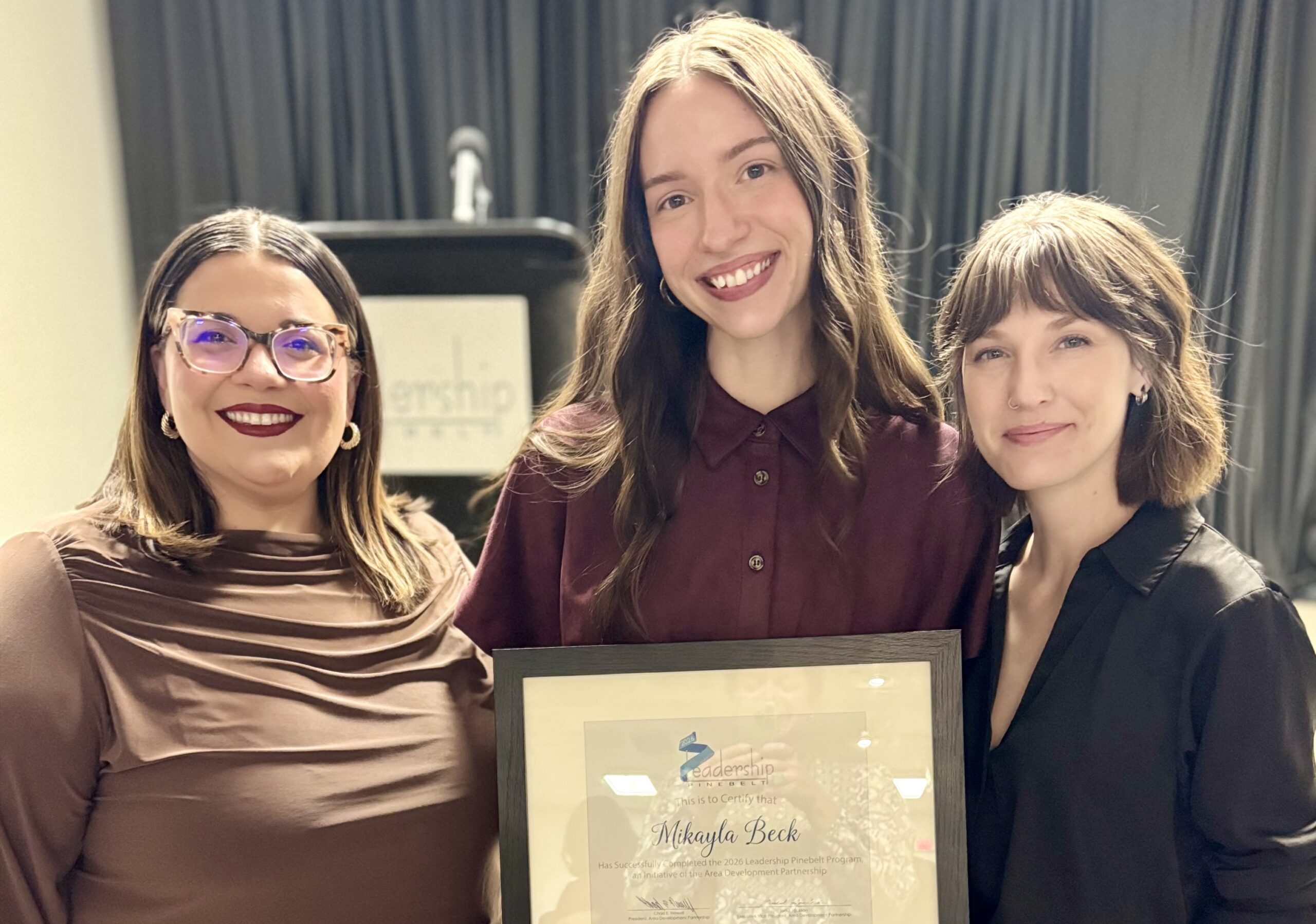
Mikayla Hollingsworth Beck, Class of 2026
And within this group, we also have another Leadership Pinebelt alumnus who believes deeply in making our community better: Wes Brooks, Class of 2013.
Wes has been pivotal in investing in Haley, Abigail, and Mikayla throughout their Leadership Pinebelt experiences, helping them get everything possible from the program and continue growing as leaders long after graduation.
This week, we had the privilege of celebrating Mikayla’s graduation alongside the rest of the Leadership Pinebelt Class of 2026. Watching another member of our BREAD team complete the program reminded me just how important it is for organizations to intentionally develop leaders.
Because leadership is tough.
Leadership can be lonely.
It can be exhilarating and incredibly heavy at the exact same time.
Leaders make decisions that affect groups of people and influence the direction an organization, team, or community will move. But leadership isn’t only about making the decision.
It’s also about building the team that can carry it forward.
That’s why so much of leadership comes back to people.
Do you have people around you who believe in the same values? Do they understand where you’re going? Are they equipped to lead others? Are you investing in them so they can become stronger leaders themselves?
Because the strongest organizations aren’t built around one leader. They’re built by developing many.
At BREAD, our values of Creativity, Unity, and Excellence aren’t meant to live on a wall. They’re meant to be lived out by people who believe in them and who are willing to pull in the same direction.
That’s why I’m so proud of our Leadership Pinebelt alumni.
I’m proud of Haley. I’m proud of Abigail. I’m proud of Mikayla. I’m proud of Wes.
And I’m proud that as BREAD grows, we’re not only focused on growing a company.
We’re growing leaders who will make our company, our clients, and our community better.
And to me, that’s leadership worth investing in.